Journey into the Cosmos
Seven episodes explore the fascinating adventure of the universe. Scientific rigor is complemented by spectacular images created with the aid of cutting-edge technology and special effects, films, animated fact sheets, and astronomical instruments. Piero Angela connects with a replica of himself in space, AstroPiero. A second correspondent, Alberto Angela, connects with the study from astrophysics laboratories and observatories around the world.
Cast spotlight
Jump into full cast pages for bio, socials, and recent work.

Landing on the Moon, visiting Venus, Visiting and Descending into the Sun
Just as the Prospector probe is launched from Cape Canaveral to the Moon to identify any traces of ice on its hidden surface, Piero Angela and his team begin their great space adventure. Aboard the Noos spacecraft, which allows Piero Angela's alter-ego and a crew of astronauts to travel at great speed in and out of our solar system, they first land on the Moon to inspect the Apollo mission site. They then continue toward Venus, passing through a dense atmosphere of gas and with strong winds. Finally, the journey concludes near the Sun, where the crew can admire sunspots, prominences, and incandescent clouds of plasma.
 Ep 2
Ep 2Exploration of Mars and the Moon Phobos, Asteroid Encounter, Flyby of Jupiter and Io
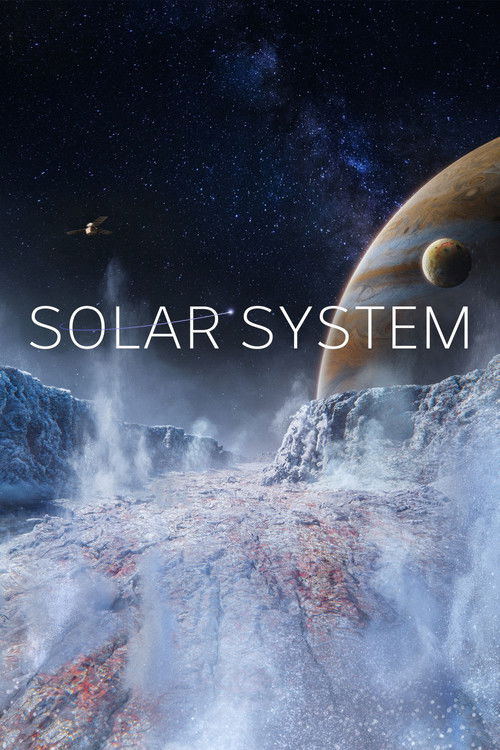
The Noos spacecraft and its crew are heading to places never before reached by man, continuing an imaginary journey supported by precise and accurate scientific information. Today's first destination is Mars, the red planet, similar to Earth in its canyons and glaciers. The crew lands on Phobos, one of its moons, and then continues their journey to Jupiter, the largest planet in the solar system, crossing the asteroid belt and reaching some of its satellites: Io, which boasts twenty-two active volcanoes, and Europa, with its splendid landscapes and its completely frozen mass. Correspondent Alberto Angela is connected from the AMES Exobiological Research Laboratories in San Francisco, the Natural History Museum in New York, which houses an extraordinary collection of meteorites, and Palomar Mountain in California, one of the most powerful observatories in the world.
Visiting Saturn, Titan, Uranus, Neptune, and the Oort Cloud
Today's imaginary journey into the cosmos targets Saturn, Uranus, Neptune, and Pluto, mysterious outer planets of the solar system millions of kilometers away from Earth. The NOOS astronauts visit Titan, traveling across its methane lakes in a special overcraft, and Miranda, Uranus's icy moon, carved by fractures and ravines. Their next stop, at the edge of the solar system, are the geysers of Triton and the Hoort Cloud: a cluster of approximately one hundred billion comets that seems to envelop the solar system like a shell. Alberto Angela is joining us from NASA's Exobiology Research Center, at El Tatio, 4,300 meters above sea level in the Andes, and from the Institute of Nuclear Physics in Frascati, Rome (where experiments are being conducted to reach absolute zero).
Journey to the Outer Solar System
The Noos spacecraft today reaches one of the eight hundred comets in the solar system, continuing through the Milky Way toward Alpha Centauri, the brightest and closest star to Earth, about eighty thousand kilometers away. Next stop are the Magellanic Clouds and the Andromeda Galaxy, surrounded by a myriad of smaller galaxies scattered across the cosmos like archipelagos in an ocean. Correspondent Alberto Angela connects first from the Chilean coast to explain the role comets played in Earth's evolution from a location reminiscent of primitive Earth, then from ESO's La Silla Observatory, also in Chile. From Mauna Kea, in the Hawaiian Islands, he then introduces us to the famous twin domes KEK1 and KEK2, equipped with state-of-the-art telescopes.
Visit the Monsters of the Sky, Namely Supernovae, Pulsars, Quasars and Black Holes
The Noos spaceship continues its adventure in space: from one end of the universe to the other to observe those stars with characteristics so surprising and unusual that they've been nicknamed the monsters of space. Today's episode features encounters with vampire stars, whose extremely strong gravitational pull sucks matter from nearby stars until they disintegrate; stellar twins, born from the same gas cloud; black holes that swallow everything that passes by; and supernovae, stars collapsed by matter weighing thousands of tons per cubic millimeter. Alberto Angela joins us from Chaco Canyon, a city abandoned hundreds of years ago where rock carvings depict the explosion of a supernova; and from Socoro, also in New Mexico, one of the world's largest astronomical observatories; before explaining Einstein's theory of relativity from the National Institute for Nuclear Physics in Frascati.
Man in Space and the Possibility of Adaptation
The Noos spaceship embarks on a surprising journey into the future today: reporter AstroPiero gives us the opportunity to discover what some of NASA's projects might look like if they were realized. First and foremost, a lunar base: a home on the moon to house astronauts and scientific equipment. But there's also another point in space, just a few hours' travel from Earth, where large orbiting stations could be built, complete with living quarters and laboratories. From these, spacecraft could be launched to reach satellites or devices in orbit, such as massive solar power plants that convert solar energy into electricity. And there are also space colonies, designed to house 2 million people: enormous cylinders 25 kilometers long and 6 kilometers in diameter that rotate, thus creating artificial gravity within themselves.

Rai 1
IT